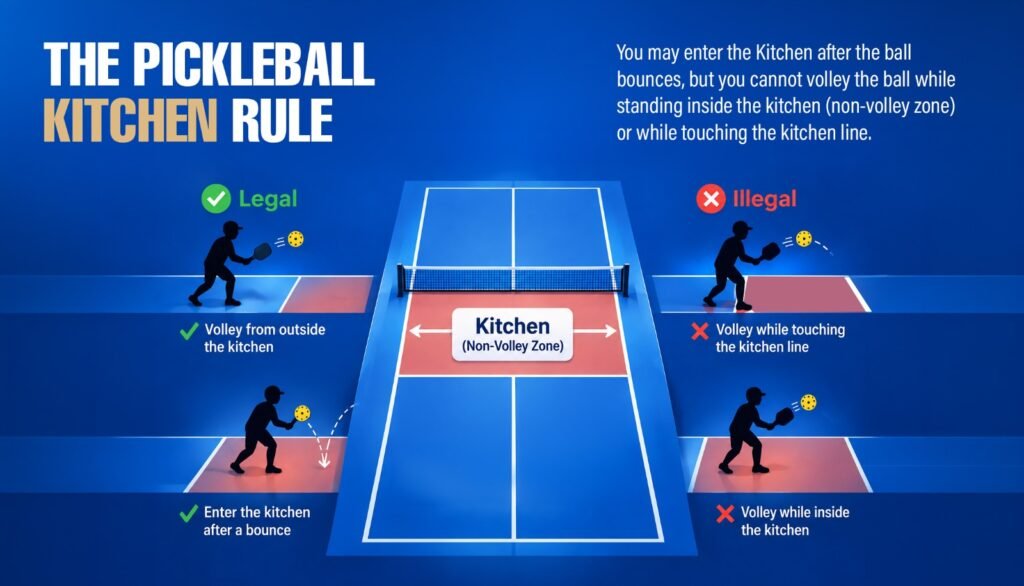
The Kitchen is the 7 foot no volley zone on each side of the net. You can stand in it, walk through it and hit a ball from inside it. The only thing you can’t do is volley (hit the ball before it bounces) while any part of you or your clothing is touching the Kitchen or its line. Once you know that one distinction, almost every other Kitchen rule falls into place.
Most players first hear the rule as “don’t step into the Kitchen,” and that phrase is the whole problem. It’s not accurate, and it’s what makes the rule feel more confusing than it actually is. Here’s what every beginner should understand about the Kitchen.
The Kitchen Restricts Volleys, Not Footsteps
The Kitchen is the official nickname for the Non Volley Zone (NVZ), the 7 foot area on either side of the net that runs the full width of the court. The line marking it counts as part of it. The name gives away the rule. It restricts volleys, not footsteps.
What to remember: you can stand in the Kitchen, move through it and hit a ball from inside it. What you cannot do is hit the ball out of the air while you’re touching it.
Stepping In Is Always Legal
This is the first thing most beginners get wrong. Stepping into the Kitchen is completely legal. If your opponent hits a soft shot that lands inside the Kitchen, you can step in, let it bounce and hit it. That’s a normal, legal shot.
What to do instead: use a simple rule of thumb. If the ball has bounced, you can hit it from the Kitchen. If it hasn’t bounced, you can’t volley it while touching the Kitchen.
Follow-Through Can Still Fault You
Here’s where it gets less obvious. Imagine you’re standing just behind the Kitchen line, your feet are technically outside it, and you reach forward to volley a ball. Your feet were outside at contact, but your momentum carries you forward afterward and your foot touches the line. That’s still a fault.
What to do instead: after a volley near the Kitchen, control your follow through the same way you’d control any other shot. If you’re likely to drift forward, take the shot a little further back.
Touching the Line Is the Same as Standing In It
A beginner might think, “my foot isn’t inside the Kitchen, it’s just touching the line.” Unfortunately, the line is part of the Kitchen. If you volley and your foot touches the line, that’s a fault, the same as if your whole foot were inside.
What to do instead: this is exactly why experienced players tend to stand slightly behind the line rather than right on top of it. That small buffer gives them room to move without accidentally clipping the line mid volley.
Reach With Your Paddle, Not Your Body
Your paddle is allowed to extend over the Kitchen line in the air. You don’t need to keep the whole paddle behind it. What matters is that you, your body, your equipment or anything you’re wearing, don’t touch the Kitchen while making the volley.
What to do instead: stand behind the line and let your paddle do the reaching. This is how strong Kitchen players appear to “reach into” the Kitchen without ever stepping into it.
Your Hat and Clothes Are Part of the Rule
The restriction isn’t only about your feet. During a volley, if your hand, your hat, your clothing or your paddle touches the Kitchen, it’s a fault, the same as if your foot did.
What to do instead: treat balance as part of your technique at the net, not an afterthought. Staying controlled through contact keeps every part of you, not just your feet, out of the Kitchen.
The Kitchen Keeps the Game From Becoming All Power
Without a no volley zone, players could camp right on top of the net and hammer every ball downward, out of their opponent’s reach. The Kitchen forces players back from the net far enough that they have to rely on dinks, drops, resets, placement and patience instead of pure power. It’s a big part of what gives pickleball its distinct, strategic character.
Position Yourself at the Line, Not Inside It
This is what confuses a lot of beginners. If you can’t volley in the Kitchen, why does everyone fight to get there? Because the target isn’t the inside of the Kitchen, it’s the line itself. Establishing yourself at or near the Kitchen line lets you play dinks, volley balls in front of you, attack higher balls and take time away from your opponent. Your opponents are working toward the same spot, which is why so much doubles strategy plays out along that line.
Slow Down Through the Transition Zone
The area between the baseline and the Kitchen is often called the transition zone, and it’s where a lot of unforced errors happen. If you charge forward the moment you return serve and your opponents hit a hard ball at your feet, you may end up hitting off balance. Good players slow down, let the ball bounce if needed and play a controlled shot before continuing forward.
What to do instead: earn your way to the Kitchen rather than sprinting to it. Move forward when you have time and a controllable ball, and stop to reset when you don’t.
Don’t Confuse Position Rules With Timing Rules
Beginners often blend these two rules together, but they govern different moments. The two bounce rule says the ball must bounce once on each side after the serve before anyone can volley. The Kitchen rule says you can’t volley while touching the Kitchen or its line, and that applies for the rest of the rally, every time, not just at the start.
What to do instead: keep them separate in your head. Two bounce is about timing, early in the point. Kitchen is about position, for the whole rally.
5 Kitchen Rules Every Beginner Should Remember
Before you step onto the court, keep these fundamentals in mind:
ㆍYou CAN step into the Kitchen. It is not a restricted area.
ㆍYou CANNOT volley while touching the Kitchen. A volley is any shot hit before the ball bounces.
ㆍThe Kitchen line counts as Kitchen. Touching the line while volleying is a fault.
ㆍYour momentum matters. Drifting into the Kitchen after a volley is still a fault.
ㆍYou CAN hit the ball from inside the Kitchen once it has bounced. That’s fully legal.
Once these basics feel comfortable, you’ll be ready to enjoy your first proper game with confidence.
Stop Losing Points to the Kitchen Rule
Almost every Kitchen fault comes down to the same root cause: volleying while some part of you is still touching the zone, whether that’s your feet, your momentum or your paddle hand. You don’t need to memorize edge cases to avoid it.
Replace “don’t go into the Kitchen” with “don’t volley from the Kitchen,” and the rest of the rule becomes much easier to apply in real rallies, including why players still fight so hard to control that line.
For structured coaching that helps you master Kitchen positioning early, book a free trial at Picklism Academy.
Frequently Asked Questions
What Should You Learn Next?