Most beginner mistakes in pickleball aren’t about talent or technique. They come down to a handful of habits around shot selection, positioning, movement and consistency, and once you know what to look for, most of them are surprisingly straightforward to fix.
Pickleball looks simple when you first start playing. The court is smaller, the paddle is easy to handle, and the game seems straightforward. Then you start playing.
Suddenly you’re missing returns, popping up dinks, getting caught in the transition zone and wondering why your opponent keeps hitting balls you can’t reach. The good news is that most beginner mistakes are not difficult to fix. They usually come down to a few habits around shot selection, positioning, movement and consistency. Here are 10 of the most common ones, and what to do instead.
1. Trying to Hit Every Ball Hard
Power is one of the easiest things to notice when watching pickleball, so beginners often assume that hitting harder means playing better. It doesn’t.
A hard shot can be useful when you have the right ball to attack. But trying to drive, smash or speed up every ball usually leads to more unforced errors. If the ball is low, behind you, outside your ideal contact point or otherwise difficult to attack, adding more power only makes the mistake bigger.
What to do instead: Learn to separate attackable balls from neutral or defensive balls. When you have a good attacking opportunity, use it. When you don’t, control the ball, reset or keep the rally going. The goal isn’t to hit the hardest shot. It’s to hit the right shot at the right time.
2. Staying Too Far Back After the Return
One of the biggest positioning mistakes beginners make is hitting their return and then simply staying at the baseline. In pickleball, your position on the court has a major effect on the shots you can play.
After returning serve, the receiving team generally has the opportunity to move forward toward the Kitchen while the serving team has to work through its third shot.
What to do instead: Hit your return and start moving forward. Don’t sprint blindly toward the Kitchen. Move with control, watch the ball and be ready to stop and play the next shot. Your goal is to work your way forward while maintaining balance and being prepared for the next ball.
3. Rushing Straight to the Kitchen
This sounds like the opposite of the previous mistake, but it’s just as common. A beginner learns that the Kitchen line is an important position and immediately starts running toward it after every shot. The problem is you can end up trying to hit the ball while running, reaching for difficult shots or arriving at the Kitchen without being ready for the next ball.
What to do instead: Earn your way to the Kitchen. Move forward when the situation allows it. After your third shot, continue advancing when you have enough time and a controllable ball. If your opponent is hitting an aggressive ball at your feet, stopping and resetting may be more important than continuing forward.
4. Treating the Court Like Two Separate Halves
Doubles pickleball is a team game. One player moves left while the other stays on the right, and suddenly a huge gap appears between them. This is especially dangerous around the middle because opponents can attack the open space.
What to do instead: Think of yourselves as a unit. When your partner moves left, you should generally shift with them. When your partner moves right, you adjust as well. The objective isn’t to stand perfectly still in your own half of the court. It’s to move together and protect the space between you. This becomes particularly important as you approach the Kitchen line.
5. Watching Your Shot Instead of Getting Ready for the Next One
You hit a great shot. Then you stand there and watch it. By the time you look back at your opponent, the next ball is already coming toward you. It’s one of those small habits that can make a big difference.
What to do instead: After every shot, ask yourself “what happens next?” Recover your balance, get your paddle back into a ready position and prepare for the next ball. Hit, recover, prepare.
6. Dropping Your Paddle After Every Shot
Beginners often let their paddle fall toward their waist or thigh after hitting the ball. That might not seem like a big problem until someone hits a fast ball directly at you at the Kitchen. At that range, you have very little reaction time.
What to do instead: Keep your paddle in front of your body and maintain a comfortable ready position. You don’t need to hold it rigidly or keep it unnaturally high. Just avoid letting it fall completely between shots. A ready paddle reduces the amount of movement you need when reacting to a volley or speed-up at the net.
7. Speeding Up Every Dink
You finally get to the Kitchen, start dinking, then see a ball and immediately attack it. The problem is that not every dink is an attacking opportunity. A ball that is too low or too close to the net can be difficult to attack safely.
What to do instead: Learn to be patient. Keep dinking until you get a ball that is genuinely attackable. This is one of the biggest differences between simply hitting shots and constructing a point. You don’t need to win the rally with every shot. Sometimes the best shot is simply another good dink. For a deeper look at Kitchen play, read our Understanding the Kitchen Rule guide.
8. Trying to Hit Perfect Shots Instead of High Percentage Shots
Beginners often aim for the corners, sidelines and tiny gaps because those shots look impressive. But every time you choose a very small target, your margin for error gets smaller. You don’t need to paint the line to win a point.
What to do instead: Start by choosing bigger, safer targets. Use the middle when appropriate. Give yourself space from the lines. Prioritise depth on returns and consistency on serves. Once your control improves, you can start using smaller targets more deliberately. Make the shot first. Make it difficult second.
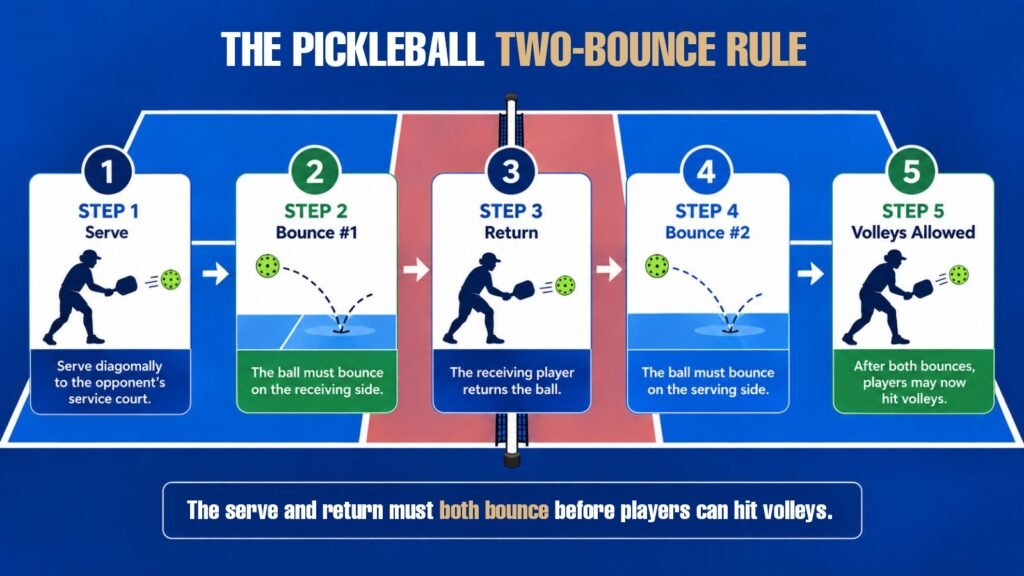
9. Forgetting the Two-Bounce Rule
This is one of the most basic rules in pickleball, yet beginners can easily forget it when the rally gets fast. The serve must bounce before it can be returned, and the return must bounce before the serving team can volley it. After those two required bounces, normal volleying can begin.
What to do instead: After serving, don’t immediately rush forward looking for a volley. Stay prepared for the return to bounce. Likewise, after returning serve, understand that the serving team still has to deal with the third shot before it can legally volley. Knowing the rule also helps you understand why players start the point from different positions.
10. Moving Your Feet Too Late
A surprising number of “bad shots” are actually movement problems. You’re reaching instead of moving, hitting while off balance, bending from the waist instead of getting your body into position, or waiting until the ball is already beside you before deciding where to go. Good pickleball technique starts before the paddle touches the ball.
What to do instead: Move early. Get your body behind the ball when possible, establish balance and then hit. At the Kitchen, use small adjustment steps rather than making large movements at the last second. The objective isn’t complicated footwork. It’s simply to arrive in a position where you can make a controlled shot.
Stop Giving Away Easy Points
Most of these mistakes have one thing in common: they hand the opponent a point without them having to earn it. A serve into the net. A return that goes long. A dink that gets popped up. A player stuck at the baseline. Someone attacking a low ball into the net.
The solution isn’t learning 20 new shots. It’s eliminating the mistakes that are already costing you points. Focus on serving consistently, returning with depth, moving with your partner, choosing the right shot and recovering after every rally. Once those become habits, everything else becomes much easier to build on.
For structured coaching that helps you identify and fix these habits early, check out Picklism Academy.
Frequently Asked Questions